Writing Contests That Allow AI
See also Award-Winning AI Literature.
FULLY GENERATED PROSE IS ELIGIBLE
These competitions allow all or almost all of the prose to be generated by AI.
🇯🇵 Short story Sogen SF Short Story Award · 18th edition, 2026 call · rules via Kobonabi
Tokyo Sogensha explicitly accepts stories whose prose is entirely or almost entirely generated by AI. Writers must explain where and how they used AI and be able to provide the complete process, including prompts and outputs.
Purse: ¥300,000. Pocket watch; magazine, ebook, and audio publication. The magazine fee is included in the cash prize.
Status: Open; closes January 12, 2027.
🇨🇦 Short story Inkshift Writing Contest · 2026
An contest for stories of 1,000 to 10,000 words. The rules explicitly allow human writing, AI assistance, AI generation, or any combination of the three.
Purse: US$1,000 to one winner. Feedback for finalists; optional publication on Inkshift’s blog.
Status: Open; closes October 31, 2026.
🇺🇸 Novel / novella The Prompty Awards · 2026 call; first awards in 2027
Requires at least half of the final prose to be AI-generated. English-language novels and novellas of 10,000 words or more are eligible, including works made entirely with AI. Entrants disclose the tools, approximate percentage of generated text, and their own creative contribution.
Purse: $1,000 grand prize; $500 Gold and $100 Silver in each of six categories. Optional publishing deal with Apateon Press for the grand-prize winner; software subscriptions. Prize details.
Status: Open; closes December 31, 2026.
🇺🇸 Short story UCSB AI/Human Creativity Contest · 2024
UC Santa Barbara invited stories written by humans, AI, or a combination of both. Judges were not told how each entry was made.
Purse: $700 for the short-story winner. Featured on the university’s Mind and Machine Intelligence website.
Status: Historical; closed April 10, 2024.
🌐 Short story Hyperstition Unslop Fiction Prize · 2026
The contest required a 500–10,000-word story generated entirely by AI, with no human-written prose or editing after generation. Entrants supplied their complete prompt setup. Official results.
Purse: $10,000 grand prize; six finalists received $500 each.
Status: Completed.
🇩🇪 Short story Mensch und Maschine · 2023
The Max Planck Institute for Biological Cybernetics and Schwäbisches Tagblatt invited short stories of about 1,500 words based on three AI-related scenarios. The announcement explicitly allowed entrants to have an AI text generator write their story. Max Planck Institute announcement and results.
Purse: €1,200 first, €500 second, €300 third, plus newspaper publication.
Status: Closed October 30, 2023; results published.
🇪🇸 Microfiction Microrrelatos e Inteligencia Artificial · 2023 and 2026
The Public University of Navarra and the Tracasa Chair invited Spanish microfiction of up to 150 words. The 2023 rules explicitly allowed stories created with full, partial or no assistance from generative AI. That edition’s theme was AI and Navarra. The 2026 edition used different wording, allowing stories partly or fully inspired by generative AI, with Navarra and music as its theme. 2026 official regulations.
Purse: €400 first, €250 second, €150 audience prize.
Status: The 2023 edition closed October 10; the fourth edition closed October 12, 2026.
🇨🇳 Short story GenWorld / ZhenFund AI Story Competition · 2023, plain-text entries
The second edition accepted plain-text stories under 5,000 Chinese characters, following an inaugural AI microfiction contest in August. The entire story had to be AI-generated, without human editing. Entrants could use any model or tool, but had to provide screenshots or video documenting the process.
Purse: Noncash. First prize included a game console or VR headset and US$25,000 in AWS discount vouchers; two second prizes offered US$15,000 in AWS discounts each, and three third prizes US$4,500 each. Winners also received game-adaptation and publication benefits. The cloud discounts are not cash.
Status: Historical 2023 competition. The second edition was announced in November.
HUMAN-AI COLLABORATION IS WELCOME
These contests invite AI into the writing process. Some require human revision or rule out entirely generated submissions.
🇫🇷 Fiction / nonfiction Prix Pascal de Littérature IA · 2026
A French-language prize built around human-AI collaboration. Entrants submit a manuscript of about 300,000 characters, a short seed for the work, and a two-page technical account of how it was made. The jury considers literary quality and the collaboration itself. The rules set no percentage limit on generated text.
Purse: No cash amount published. Publication and media visibility.
Status: Open; closes November 30, 2026.
🇯🇵 Short story Nikkei Hoshi Shinichi Award · 2021–2026; current rules for the 14th edition
The 2021 rules already accepted AI entries with a human representative. By 2024, generated prose had to be revised by a human, with prompts and before-and-after versions kept for review. The current rules retain those requirements. The general division accepts Japanese stories of up to 10,000 characters.
Purse: ¥1,000,000 general-division Grand Prix. Trophy; other awards include goods and book vouchers. The junior Grand Prix is ¥100,000 in book vouchers, not cash.
Status: Closed October 6, 2026; results expected February 2027.
🇯🇵 Fiction AI Novelist Literary Award · 2022 and 2025
A Japanese prize specifically for work made with the AI Novelist writing tool. The first edition in 2022 accepted fiction and shorter forms including poetry and scripts, with an account of the process. The second edition, in 2025, received 223 entries.
Purse: ¥500,000 top prize in both editions; other awards of ¥100,000. Twelve months of AI Novelist Platinum membership for these winners. Prize details.
Status: Historical; second-edition winners announced in 2025.
🌐 Novel opening / screenplay Voltage Verse · 2025
A competition from the WritingWithAI community for novel openings and screenplays. Entries had to use AI, but could not be entirely AI-generated. Writers supplied a paragraph explaining their process. Novel entries could be up to 5,000 words.
Purse: $550 first prize in each of the novel and screenwriting categories. Writing-software and community memberships; packages differ by category.
Status: Historical; closed August 21, 2025.
🇯🇵 Serial novel Piccoma Novels Prize: SMARTOON Original Novel Contest · 4th prize, special edition, 2026
This Japanese novel competition distinguishes AI-written text, AI support that leaves no generated text in the manuscript, and writing without AI. AI rewriting of human prose counts as generated text, even after further human edits. Generated writing is eligible if the author contributes creatively and keeps process records. The submitted novel must contain at least 20 episodes and 60,000 characters.
Purse: No fixed cash prize published. Paid serialization through manuscript fees and revenue sharing; SMARTOON adaptation is subject to contract and production requirements.
Status: Open; closes November 4, 2026.
🌐 Essay Essay Architecture Prize · 2025 submissions; 2026 results
An English-language essay competition that explicitly allowed AI for brainstorming, drafting, and editing. Entrants completed a survey about their process, and AI use was not penalized. The organizers described the goal as augmenting the writer rather than automating the work. Essays could be 400 to 10,000 words and respond broadly to life in 2025.
Purse: US$10,000 grand prize. Anthology publication and a royalty share for the winner and selected finalists.
Status: Historical; submissions closed November 23, 2025.
🇲🇾 Screenplay Future Stories: AI Script Writing Competition · 2022
SeaShorts, Wu Ben Film Magazine, and the University of Nottingham Malaysia invited Southeast Asian writers to write scripts with AI. Writers could use any AI writing application. The published selections credited tools including NovelAI, InferKit, and HyperWrite.
Purse: RM1,000 for the best script. Selected scripts showcased through the organizers.
Status: Historical; 2022 competition.
🇨🇳 Short fiction / nonfiction October magazine’s “县@智” homecoming-writing contest · 2025
The Chinese literary magazine invited young writers to work with DeepSeek or another AI on stories and nonfiction about returning home. Writers had to explain the AI’s role and their own revisions. The call said the amount of AI involvement would not affect scoring, while discouraging the use of a single prompt to produce the entire piece.
Purse: CNY10,000 top prize; two CNY3,000 special awards; CNY1,000 weekly awards. Online publication, with possible selection for the magazine.
Status: Historical; closed March 31, 2025.
🇨🇦 Fiction / essay AI Pen Awards / AIFWAA · Launched 2025; 2026 cycles
A Montreal-based award program devoted to writing made through human-AI collaboration. Submissions must describe the tools, the extent of AI involvement, and the creative process. The organization runs fiction awards and an Essay Lab. Its public materials do not give a clear percentage boundary between assisted and fully generated work.
Purse: No cash amount found in the reviewed public guidelines. Award recognition and inclusion in the organization’s showcases. Prize details.
Status: Next fiction deadline December 31, 2026; Essay Lab has rolling submissions.
🇮🇳 Short story / poetry Spin Your Science, India Science Festival · 2026 competition for ISF 2027
The festival permits AI to enhance or augment stories and poems, provided writers disclose it. Fully generated entries are disqualified. The rules do not define a permitted percentage or spell out every acceptable drafting use. There are categories for writers under 15 and those 15 or older, and winners need an Indian bank account to receive payment.
Purse: INR30,000 first, INR20,000 second, and INR10,000 third in each of two age groups. Selected writing included in the festival anthology. Prize details.
Status: Closed June 30, 2026; winners scheduled December 2026.
🌐 Novel The Inkys: AI-Assisted · 2026
A dedicated category for English-language stories of at least 20,000 words first published on Inkitt in 2026. AI must have been used somewhere in the writing process. The rules do not specify a maximum AI-generated share or separately establish that wholly generated books qualify.
Purse: $500, $250 and $100; first place also receives a trophy. Additional benefits include badges and 200,000/100,000/50,000 audiobook credits.
Status: Closed October 18, 2026; winners scheduled by December 18.
🇭🇰 School writing Human-AI Creative Writing Contest · 2022 and 2022–23
The original school contest required an AI text generator and allowed students to combine generated text with their own words. The 2022–23 inter-school edition required students to design an AI writing tool on Hugging Face Spaces and submit a story of no more than 500 words containing both their own and generated words, with human-written words highlighted. 2022–23 rules and prizes; Organizer’s edition archive.
Purse: In 2022–23, HK$1,000 first and HK$500 second in book vouchers, both overall and within participating schools. The 2022 rules page does not state a purse.
Status: Historical editions completed.
🌐 Short story AIStoryHub Short Story Contest · August 2026
Entrants had to use AIStoryHub somewhere in drafting a story of at least 5,000 words. The contest encouraged its AI writing tools but did not publish a maximum generated-text percentage. Writers remained responsible for their submissions. Official rules.
Purse: $300, $125 and $75 in Anthropic API credit, not cash.
Status: Closed August 31, 2026.
🌐 Fiction / poetry / essay / script AI Creativity Awards: Writing & Narrative · 2026
The writing category accepts poetry, fiction, scripts and essays. AI must materially contribute; entrants disclose tools, generated components and their human creative role. The policy permits prompt-led work, editing and generation of portions of a work. AI policy; Prizes; Rules.
Purse: No cash prize. Winners receive digital certificates, laurels and an online showcase.
Status: Entries close November 1, 2026; results scheduled December 1. Entry fees £35 standard or £15 student.
🇯🇵 Novel / short story Net Novel Award / Netcon 15 · 2026 call; 2027 awards
The competition accepts works labeled “AI indirect use” or “AI supportive use,” while excluding “AI direct use.” The linked platform definitions expressly allow AI drafts that the author entirely rewrites in their own expression. This is broader than proofreading alone, but excludes pasted generated passages or merely swapping a few words. Sponsor publishers retain final discretion over award eligibility. Linked platform AI definitions.
Purse: ¥1,000,000 grand prize; ¥500,000 gold; ¥300,000 excellence; ¥100,000 selected and second-chance awards; ¥10,000 short-story awards.
Status: Opened October 14, 2026; closes January 13, 2027.
🇪🇸 Short story El coloquio de los perros · 23rd edition, 2025
The Spanish-language short-story competition explicitly allowed AI for creating, improving or retouching the text. Stories of roughly 1,200–2,300 words had to address the theme of artificial intelligence. The permission is about the writing process, not merely the subject. No percentage limit is stated.
Purse: First prize valued at €300 and a €100 runner-up award, plus publication. The rules do not clearly identify the first prize as cash.
Status: Closed July 1, 2025.
🇪🇸 Short story International Short-Story Competition for Stories Written with AI · 2026 call; 2027 award
Writer Antonio Blázquez-Madrid’s first competition requires Spanish stories of 600–1,200 words about the future, with 60–80% AI contribution and 20–40% human contribution. Entrants must be adults. The rules describe AI judging and detector-based checks; the percentages are the organizer’s requirement.
Purse: The cash equivalent of three months of ChatGPT Plus, plus anthology publication and a diploma. No fixed currency or monetary amount is specified.
Status: Announced in September 2026; closes January 15, 2027.
🇩🇪 School writing Bunte Feder: Echt?!? · 2023–24
The school’s writing competition included a special “Echt?!?” category requiring AI use. Pupils submitted both the resulting text and the chat transcript; judging considered the product and creative use of AI. Entries were limited to three pages.
Purse: No amount specified in the official rules.
Status: Closed February 8, 2024.
🌐 Short story WritingWithAI Discord 500-Member Writing Competition · 2026
The community contest explicitly welcomed AI-assisted stories. Entries of 400–3,000 words used the theme “Second Chances” and a briefcase prompt, with community voting and feedback. The announcement does not specify a cap on generated text. Organizer’s follow-up.
Purse: No cash. Three winners receive special Discord roles.
Status: Closed April 21, 2026.
🇨🇳 Screenplay Shanghai University Student Television Festival: AI Screenplay Track · 18th edition, 2025
The 18th festival added an AI screenplay category encouraging human-AI collaboration. Entrants must originate a 300–500-character synopsis and submit a collaboration statement of at least 500 characters. Permitted uses include generating scene conflicts, exploring plot alternatives and improving dialogue.
Purse: CNY1,000 Lilac Grand Prize; CNY800 gold, CNY500 silver and CNY300 bronze awards. The grand winner is selected from the gold winners and does not also collect the gold payment.
Status: Closed October 25, 2025.
🇰🇷 School novel / story International AI Tooning Contest: Novel / Story Division · 2nd edition, 2026
The novel and story division accepts a proposal and three episodes of at least 2,000 characters each on the theme “My Day in 2036.” Primary and secondary students worldwide can enter using Tooning’s AI authoring tools. Generated content is allowed subject to third-party rights; the rules state no percentage limit.
Purse: Noncash. The overall competition offers iPads for two grand awards, Galaxy Buds for four excellence awards, and KRW10,000 gift cards for university merit awards. These prizes span four media divisions; they are not all reserved for prose.
Status: Closes October 30, 2026.
🇨🇳 Short story Seal Prize / Haibao Science Fiction Competition · Edition zero, 2026
A published transcript of the organizer’s March 2026 announcement describes permission for AI writing assistance, with disclosure. A special Fishing Rod award recognizes inventive AI workflows, without excluding those entries from the main awards. Human and AI judging operate in parallel. No maximum generated-text share is stated. Original announcement video.
Purse: Human jury: CNY30,000 special and first prizes, CNY20,000 second prizes and CNY10,000 third prizes. AI jury: CNY32,768 / CNY16,384 / CNY8,192 / CNY4,096. Five workflow prizes pay CNY4,000 each. Human and AI awards may be combined.
Status: Closed May 8, 2026.
🇫🇷 Short story Panodyssey: Les plumes vagabondes, AI Creative Writing Prize · 2024
Panodyssey’s summer competition included a dedicated prize for short, original stories about human-machine friendship. Entrants had to use at least one generative AI tool and could submit up to five stories exploring different collaborative methods. Community engagement helped determine the shortlist, with a jury making the final selection. No generated-text ceiling was specified.
Purse: €100 for the AI-category winner, withdrawable from the winner’s Panodyssey wallet, plus promotion.
Status: Ran July 1–September 21, 2024.
🇫🇷 School writing Florilège-FIPF World Collaborative Creative Writing Competition · 2025–26 and 2026–27
The 11th edition, themed IntelligenceS, explicitly accepts class projects made with AI. Entrants must document tools, prompts, revisions and creative decisions; judges consider how thoughtfully students transform and reflect on generated material. Genres include poetry, stories, theatre and comics, with text entries limited to 5,000 characters. Individual student entries are excluded. 2026–27 announcement quoting the new rules.
Purse: No cash listed. Winning classes receive a diploma and publication in the annual print and digital Florilège anthology.
Status: Opened September 25, 2025; closed March 31, 2026. A 2026–27 successor also permits AI and closes March 31, 2027.
🇨🇱 School illustrated microfiction Chiloé Bicentenario con IA: Story and Drawing · 2025
Fundación Apptitudes’ school competition requires an original microstory set in Chiloé, written with AI support and paired with AI-generated illustrations. The submission is a PDF of up to three pages. It is open to students enrolled in Chiloé’s ten municipalities and expressly promotes creative refinement of generated text and imagery. Organizer’s contest site.
Purse: Noncash prizes include a laptop, a desktop computer and a sponsor prize, each accompanied by a CLP100,000 gift card. The published materials differ on how awards are allocated across categories.
Status: Historical 2025 contest anticipating the 2026 bicentennial; the published deadline dates conflict.
🇭🇰 Poetry HKBU International Writers’ Workshop AI English Poetry Competition · 2023–24
Hong Kong Baptist University’s International Writers’ Workshop invited full-time undergraduates in UGC-funded programs to create an English poem using AI. Entrants submitted a poem of up to one A4 page, a 250-word artist statement and their AI interaction records. The poem and the documented creative process carried equal weight. AI could be used at any stage; the rules did not impose a generated-text ceiling. University announcement; Organizer-and-judge research paper describing the competition, section 3.1.
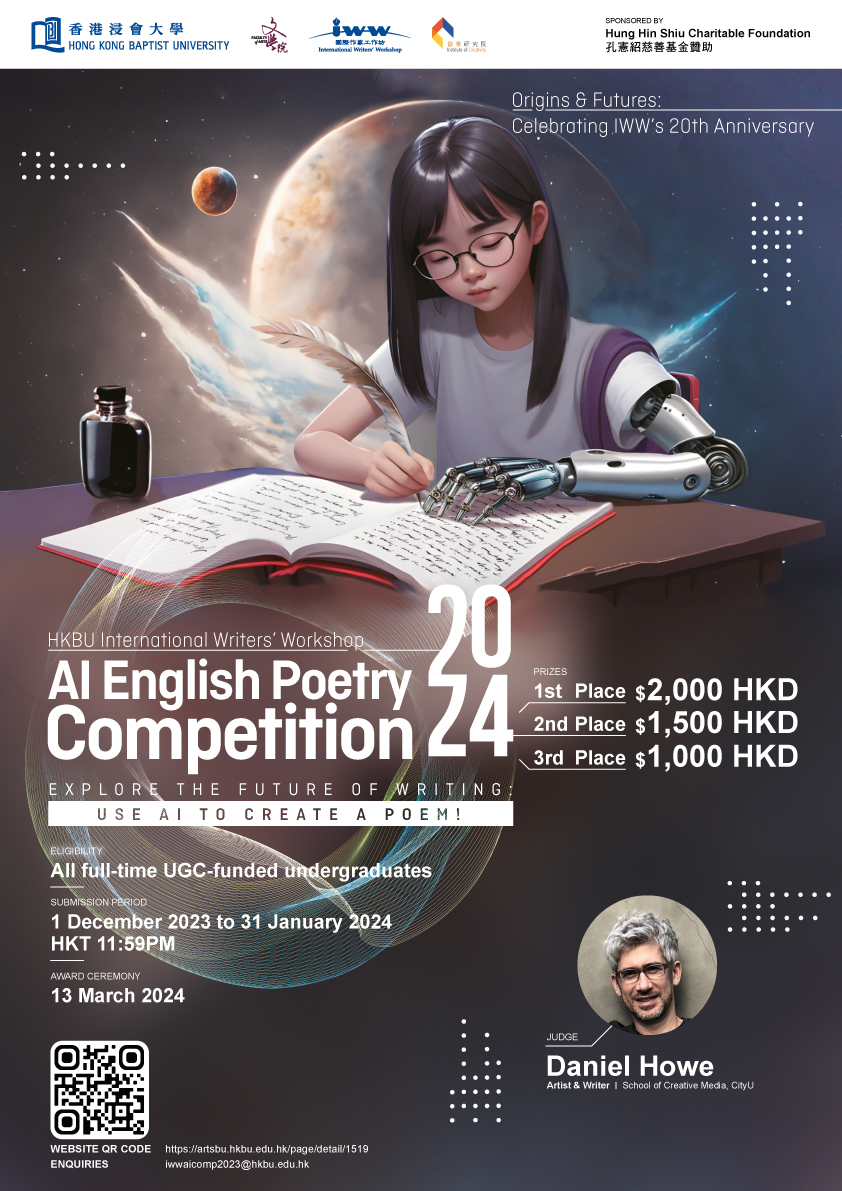
Purse: HK$2,000 first, HK$1,500 second and HK$1,000 third.
Status: Opened December 1, 2023; awards ceremony March 13, 2024.
LIMITED AI ASSISTANCE IS ALLOWED
These rules permit support such as brainstorming, research, or proofreading. Most explicitly exclude generated prose. Where a policy only names particular support uses, the entry says so.
🌐 Novel manuscript RevPit Annual Contest · AI policy effective February 24, 2024
Revise & Resub permits AI for brainstorming, outlining, grammar, proofreading, and self-editing. It rejects AI-generated manuscripts and submission materials. A writer cannot make an AI-written draft eligible simply by editing it heavily. The contest is for unagented fiction writers.
Purse: No cash purse advertised. Editorial feedback and consultation, query and opening-page editing, and a showcase. Prize details.
Status: Annual program; check the next contest schedule.
🇺🇸 Youth writing / portfolio Scholastic Art & Writing Awards · AI policy effective July 2025; 2026 awards
The awards allow AI for research, brainstorming, outlining, and editing original work, but not an AI-generated final submission. Entrants must disclose use and may need to show their creative process. Portfolio scholarships are for graduating seniors submitting a collection of work.
Purse: $12,500 Gold Medal Portfolio and $2,000 Silver Medal Portfolio scholarships. Other honors and scholarships vary; ordinary medals do not automatically carry these amounts. Prize details.
Status: Annual program; deadlines vary by region.
🌐 Youth writing Write the World monthly competitions · 2026
These international contests allow AI for brainstorming, but the draft itself must be written by the entrant. AI-generated writing is disqualified. The competition rules are stricter than the platform’s rules for ordinary posts. Genres change each month and include fiction, poetry, essays, and dramatic writing.
Purse: Usually $100 winner; $50 runner-up; $50 best peer reviewer. Publication and feedback; some competitions add other prizes. Prize details.
Status: Monthly competitions for ages 13–19.
🌐 Short story Short Fiction Break / The Write Practice · Summer 2026 contest
The summer contest allowed AI for brainstorming, research, grammar, feedback, and critique. Stories primarily or entirely written by AI were ineligible, even after human rewriting. Writers had to disclose how they used it.
Purse: $300 grand prize; $100 runner-up. Publication and workshop-related benefits.
Status: Closed July 7, 2026.
🇩🇪 Romance novel DELIA Literaturpreis · 2026 publications; 2027 novel award
The German romance prize allows AI for structure, research, spelling, grammar, and stylistic checks. Books written entirely or substantially by generative AI are excluded. The policy also covers the cover: small supporting AI elements can be acceptable, while a wholly generated cover is not. This edition considers German-language novels first published in 2026.
Purse: €1,500. Award trophy.
Status: 2026 call; submission deadlines depend on publication date.
🇯🇵 Novel Dengeki Novel Prize · 34th edition, 2026 call
The Japanese novel prize permits AI for ideas, proofreading, and polishing expression. It excludes entries whose body text or main story structure was generated by AI. Entrants must identify the tools and their purpose and keep records of the process.
Purse: ¥3,000,000 Grand Prize; ¥1,000,000 Gold; ¥500,000 Silver; two named awards of ¥1,000,000 each. Publication for selected award winners.
Status: Closes April 10, 2027.
🇯🇵 Mystery novel Japan Mystery Literature Award for New Writers · 31st edition, 2026 call
Kobunsha’s newcomer prize allows AI as a supporting tool for ideas, plot development, proofreading, and expression. AI-written prose or the work’s main structure is not eligible. Writers must disclose the tool and its role on the manuscript’s cover sheet.
Purse: ¥5,000,000. Scheherazade statue; publication.
Status: Closes April 9, 2027.
🇯🇵 Children’s novel Kadokawa Tsubasa Bunko Novel Award · 15th edition, general division, 2026
The general division for children’s novels permits AI for brainstorming, proofreading, and polishing expression. Generated body text or a generated main structure is excluded, and writers must disclose the tools and preserve records. This is the general division for people writing children’s books, rather than the separate division for child entrants.
Purse: ¥500,000 Grand Prize; ¥300,000 Gold; ¥100,000 Silver. Plaque or certificate; publication opportunities.
Status: Closed August 31, 2026; results expected March 2027.
🇯🇵 Mystery novel Kono Mystery ga Sugoi! Award · 26th edition, 2026 call
The rules allow supporting use of generative AI if the writer briefly explains how it was used in the application. They separately prohibit manuscripts containing AI-generated prose.
Purse: ¥12,000,000 Grand Prize; ¥2,000,000 Bunko Grand Prix. Publication.
Status: Closes May 31, 2027.
🇯🇵 Short fiction R-18 Literary Prize for Women by Women · 26th edition, 2026
Shinchosha’s FAQ permits AI as a supporting tool for research and idea generation, subject to its rules on third-party rights. It does not give the same explicit permission for generated prose. The contest accepts short fiction from people who identify as women.
Purse: ¥300,000 Grand Prize; ¥100,000 Tomochika Prize. Sponsored travel and other goods, depending on the award. Prize details.
Status: Closed October 26, 2026.
🇮🇳 Essay UrbanScripts / ArchitectureLive · 2023
An essay competition about Indian cities and neighborhoods for Indian residents aged 18–30. AI could help with grammar and spelling, but AI drafting was expressly prohibited.
Purse: ₹15,000 each for three winners; ₹5,000 each for five special mentions, plus books, certificates and publication.
Status: Closed September 10, 2023.
🇯🇵 Novel Earth Star Bunko Character Novel Award · 1st edition, 2026
The Japanese novel competition excludes AI-generated manuscripts while allowing ideation and proofreading or polishing. Organizers may request records of prompts and outputs.
Purse: ¥1,000,000 grand prize, with two-volume publication and manga adaptation; ¥500,000 gold; ¥200,000 silver; ¥100,000 judge and manga awards.
Status: Closes November 18, 2026, at 11:59 a.m.
🇧🇷 Novel / poetry / aphorism Henrique José de Souza International Literature Prize · 6th edition, 2026
The Portuguese-language award permits AI for research, grammar, spelling and technical support. Wholly or predominantly generated work is ineligible. Categories include novels, poetry and aphorisms, with category-specific eligibility.
Purse: Novel: R$5,000 and publication. Poetry: R$3,000/R$1,000/R$800. Aphorisms: R$1,000/R$500/R$300.
Status: Poetry and aphorisms closed July 20; novels closed August 15, 2026; results scheduled November 15.
🇺🇸 School writing K12 National Writing Competition · 2025–26
US school students could submit poetry, fiction or nonfiction. AI could help brainstorm ideas, but no generated text could appear in the final entry.
Purse: $250 first and $100 second per grade/category, plus $50 People’s Choice awards. Winners can choose cash or an Amazon e-gift card.
Status: Closed January 20, 2026.
🌐 Short story Next Generation Short Story Awards · 2026 call; 2027 awards
English-language unpublished stories of up to 5,000 words. Research, idea exploration and grammar or style checking are permitted, but generated or AI-paraphrased story text is ineligible. The policy also prohibits using AI-created stories or plots as the creative foundation, so “brainstorming permitted” needs that qualification. Award details.
Purse: $500/$300/$200 grand prizes; $75 category prizes, plus medals and anthology publication for selected winners.
Status: Closes January 28, 2027. Entry fee $25 for a first category and $20 for each additional category.
🇨🇦 Youth writing Surrey Libraries Youth Writing Contest · 2026
For eligible young residents of Surrey, British Columbia. AI can support research and ideas, including plot development, if disclosed. AI cannot generate or modify the submitted content. Categories include short stories, poetry, comics and other writing.
Purse: C$350/C$200/C$100 in each category.
Status: Closed July 20, 2026.
🇨🇦 Short story In Places Between / Robyn Herrington Memorial Contest · 2026
For writers under 18 in Alberta and the Northwest Territories, submitting stories of up to 4,000 words. Very limited AI brainstorming is allowed; AI cannot supply the story text or most of its ideas.
Purse: C$45 for each of ten selected stories, plus an anthology copy.
Status: Closed April 1, 2026; winners selected.
🌐 Short story Carrie Turansky Valentine Romance Contest · 2026
A small author-run contest for clean inspirational romances of up to 2,000 words. The rules expressly allow AI brainstorming and grammar or spelling help, while prohibiting generated drafts.
Purse: No cash. Three winners receive a novel, with print copies for US winners or ebooks internationally; the winning story is published on the author’s blog.
Status: Closed February 12, 2026.
🇯🇵 Novel Shōsetsu Gendai Long Novel Newcomer Award · 21st edition, 2026
Kodansha’s novel competition accepts supportive AI use, including plot creation and assistance with written expression, provided the entrant describes the use at the start of the manuscript. The rules do not supply a generated-text threshold or explicitly permit wholly generated novels. TBS interviews with literary-prize editors.
Purse: ¥3,000,000, divided if there are multiple winning works, plus book publication.
Status: Closed July 31, 2026; announcement planned in the magazine’s January–February 2027 combined issue.
🇯🇵 Literary fiction Kyoto Literature Prize · 5th edition, 2024–25
The rules allow AI as a reference when developing ideas or plots, but prohibit adopting an AI-created plot unchanged. AI is prohibited during prose drafting and revision, except for an objectively justified reason such as representing words spoken by an AI within the story.
Purse: General division: ¥1,000,000 first and ¥500,000 second. Overseas division: ¥100,000. Secondary-school division: ¥100,000 and ¥50,000 in book cards.
Status: Rules issued in 2024; closed May 9, 2025.
🇯🇵 Light novel GA Bunko Award · AI policy dated December 2024; 19th edition, 2026
The award allows AI only for ideas and proofreading language or expression. Applicants must disclose their use and retain complete prompt/output records. Entirely or predominantly generated works are excluded. The current AI clause is explicitly marked as updated December 1, 2024.
Purse: Current listings report ¥3,000,000 grand prize, ¥1,000,000 gold and ¥200,000 silver. The current official prize panel could not be verified.
Status: The 19th edition’s second-half deadline is November 30, 2026, with final awards planned for April 2027.
🇯🇵 Novel GA Web Novel Contest · 2nd edition, 2026
Entrants publish Japanese fiction of at least 50,000 characters on Kakuyomu. The rules allow AI for ideas and proofreading but exclude AI-written works. Organizers may request complete records of how the tool was used.
Purse: ¥1,000,000 grand prize, with a three-volume publication commitment and manga adaptation. Special and manga awards offer publication and a memento; no separate cash amount is specified for those awards.
Status: Closed October 2, 2026; final results expected February 2027.
🇯🇵 Children’s fiction Ogawa Mimei Literature Award · 35th edition, 2026
The children’s-fiction award permits AI for feedback, corrections and searching for subjects, episodes or ideas. Its FAQ explicitly rejects entering a story built by adding to or making minor changes to an AI-created story. Both short and longer children’s fiction categories are available. Official rules; Official FAQ, item 16 on page 2.
Purse: ¥1,000,000 grand prize with publication by Gakken, and ¥200,000 excellence award.
Status: Closes October 31, 2026.
🌐 Short story NOVELOUS Worlds Monthly One Shot Challenge · October 2026
The Honeyfeed-based short-fiction competition permits AI brainstorming, grammar checks and similar minor support. It prohibits AI acting as writer, coauthor or editor, and excludes fully or partially generated stories. The October prompt is “Bloodbound.” Entries must be original, previously unpublished and exclusive to Honeyfeed.
Purse: $100 for the judges’ choice winner, plus featured publication. Author contracts and commissions are described as opportunities rather than guaranteed prizes.
Status: Closes October 31, 2026; winner scheduled December 1.
🇩🇪 Youth writing SüdStormarn Youth Writing Competition · 2026–27
The church youth program allows AI for spelling, grammar, clarity and organizing ideas, with prompts supplied. AI-assisted work can enter the competition, but only AI-free writing is eligible for publication. Formats include short stories and poetry slam texts.
Purse: Not finalized. The organizer describes planned book vouchers, materials and certificates without amounts.
Status: Closes December 31, 2026.
🇺🇸 Essay FAMU Write Your Way Up / America250 · 2026
The reflective essay competition permits AI brainstorming and limited editing, while requiring the final work to be original. Essays of 750–1,200 words address freedom. Eligibility is restricted to specified FAMU, school and Tallahassee community groups.
Purse: No cash amount stated on the official page reviewed. Winning essays are published.
Status: Closed March 31, 2026; results available.
🇩🇪 Short story Schreiblust-Verlag Short-Story Competition · 2026–27
The publisher permits AI for research and spelling or grammar checks, but forbids AI creative ideas, prose and stylistic rewriting. The current call seeks travel stories of up to 10,000 characters including spaces. This is a competitive anthology selection. Publisher’s AI policy.
Purse: No cash amount stated. Selected stories receive anthology publication and a complimentary copy.
Status: Closes December 31, 2026; publication planned for summer 2027.
🇮🇹 School historical fiction Storia di storie · 2026
The publisher’s historical-fiction competition is for Italian middle-school classes, with teacher-submitted individual, group or class entries of up to 6,000 characters. AI is allowed for research only; writing, revision and rewriting with AI are prohibited.
Purse: No cash prize listed. The first story is adapted into a narrative podcast; second and third receive illustrated online publication.
Status: Closed April 20, 2026, with results scheduled May 15.
🌐 Novel SDO Originals Writing Competition · 2026–27
Sky Demon Order’s first English-language novel competition permits AI editing, proofreading and brainstorming, while requiring the prose itself to be human-written. Entries must reach 50,000 published words and remain exclusive to the platform until the competition closes. Reader metrics create the shortlist; editors select the winners.
Purse: $500 first, $250 second, $100 third, plus homepage promotion and badges.
Status: Opened October 5, 2026; closes April 30, 2027.
🌐 Short story The Scary Tapes · 2026
This speculative-horror competition accepts stories of 7,000–11,000 words with AI central to the horror. Its production policy separately permits light AI brainstorming and organization, rated no higher than 2 on the organizer’s REAL scale. Generated prose and audio are prohibited. Open to adults. Organizer FAQ.
Purse: Up to five winners receive $500 each and an audio-podcast reading.
Status: Closed July 17, 2026, or upon reaching 1,000 qualified submissions.
🌐 Short writing Mormon Lit Blitz · 15th edition, 2026
The competition accepts writing in any genre or language, up to 1,000 words, intended to resonate with a Latter-day Saint audience. AI may support research, coaching and identifying revision opportunities, with disclosure. It cannot supply the text, rewrite passages, decide character behavior or originate the entry’s premise. This is narrower than unrestricted brainstorming permission. Detailed AI policy.
Purse: $125 audience-choice award and $125 judges’ award. Each selected finalist also receives $25, with online and later anthology publication.
Status: Closed May 31, 2026.
🇯🇵 Short story Sōgen Mystery Short Story Prize · 4th and 5th editions, 2026–27 · current rules via Kobonabi
The fifth edition restricts AI to assistance such as suggesting names or proofreading; entirely or predominantly generated prose is ineligible. The fourth edition had allowed entirely or predominantly generated stories, limited to one such entry per writer, with disclosure and retained process records. The current policy is narrower than the separate Sogen SF prize’s rules.
Purse: ¥300,000, a pocket watch, magazine publication and audio distribution.
Status: Fourth edition closed March 31, 2026; fifth closes March 31, 2027.
🇯🇵 Novel Shōsetsu Yasei Jidai Newcomer Award · 18th edition, 2026
KADOKAWA’s entertainment-novel award permits supportive generative AI for plotting and checking expression. Entrants must explain the use at the end of their manuscript. This does not establish permission for entirely generated novels.
Purse: ¥1,000,000 and a commemorative item, with publication planned.
Status: Closed August 28, 2026; final selection in March 2027.
🇯🇵 Mystery / horror novel Yokomizo Seishi Mystery & Horror Award · 47th edition, 2026
The Japanese novel competition permits supportive generative AI for plot creation and expression checking, with a statement describing its use at the manuscript’s end. It accepts unpublished mystery and horror novels from professionals or amateurs.
Purse: ¥3,000,000 grand prize with a Kindaichi Kōsuke statuette and book publication; ¥300,000 excellence award. The readers’ award has publication but no cash.
Status: Closed September 30, 2026; results expected April 2027.
🇯🇵 Short story Shueisha Short Story Newcomer Award · 241st round, 2026
Orange Bunko’s short-story competition permits AI for research and assistance with revision, but explicitly prohibits using it to write the body text. Entrants must not have commercially published a novel. Manuscripts are 25–30 standard Japanese manuscript pages.
Purse: ¥200,000 selected award and ¥100,000 honorable mention.
Status: Closes December 31, 2026; results expected May 2027.
🇯🇵 Novel Kadokawa Bunko Character Novel Award · 13th edition, 2026 call
AI may help with proofreading, expression polishing and brainstorming, with disclosure and process records. AI-generated prose or major structural elements are ineligible. The contest seeks Japanese entertainment novels built around memorable characters.
Purse: ¥1,000,000 grand prize, ¥300,000 excellence, ¥200,000 encouragement, ¥100,000 web readers’ award and ¥100,000 Kakuyomu theme award.
Status: Closes May 7, 2027.
🇯🇵 Short story Keio Railway × Nola: Stations, Towns and the Future · 2026–27
A Japanese short-SF contest seeking roughly 4,000-character stories involving a station and a future around 2050–2100. Generative AI is explicitly permitted for ideas, proofreading and research. Submitting unchanged AI output is prohibited, and entrants must retain models, purposes and prompts.
Purse: ¥50,000 grand prize; up to five ¥10,000 special awards; one ¥10,000 book-card award. Selected stories are planned for railway and station displays.
Status: Opened October 20, 2026; closes January 12, 2027.
🇯🇵 Fiction / nonfiction Energy Forum Novel Award · 13th edition, 2026
The Japanese novel award seeks fiction or nonfiction about energy, the environment or science. The rules exclude generative-AI-written work but expressly exempt AI use at the idea stage from that prohibition. Corroborating call.
Purse: ¥300,000, divided if multiple winners, plus a clock and book publication. The amount includes first-edition royalties and ceremony travel expenses; later editions pay a separate 10% royalty.
Status: Closed May 31, 2026.
🇨🇳 Fiction / nonfiction Wenzhi Cup University Writing Competition · 25th edition, 2026–27
Shanghai Jiao Tong University’s competition accepts fiction and prose nonfiction from university students across China, including international students. It allows research, proofreading and general revision suggestions, but AI cannot substantially replace the core conception or principal writing. Finalists must also complete an on-site timed writing round; judges consider both stages, not detector scores alone.
Purse: In each of two categories, up to three CNY5,000 first prizes, up to five CNY3,000 second prizes, and CNY800 excellence awards.
Status: Submissions close December 31, 2026; on-site final February 14, 2027.
🇨🇳 Short fiction Taizhou Online Literature AI+ Short Creation Competition · Prose category, 2026
The prose category accepts completed stories of 5,000–30,000 Chinese characters. AI may help generate inspiration, organize material or polish writing, with disclosure. The core story and text must be original; entirely AI-generated entries are forbidden.
Purse: Five CNY8,000 outstanding-work awards in the prose category, plus CNY1,000 popularity and creativity awards.
Status: Closed in 2026. The prose section gives June 30, while the overall event window ends August 31.
🇩🇪 Short story Dark Sky Nord: Welcome to the Dark Side of the Night · 2026
This German-language short-story competition expressly permits AI research, spelling and grammar correction, and checking writing rules, with disclosure. AI-originated story ideas, creative development and prose are excluded. Stories must concern natural darkness and the night, with a maximum of 10,000 characters excluding spaces.
Purse: Noncash: first prize is a guided stargazing tour in the Rhön; second a night-sky travel book; third an amber reading lamp. Selected stories are published online.
Status: Closed June 21, 2026; winners announced August 13.
🇧🇷 Short story Sempre Textos + Hanoi Editora Short Story Competition · 2026
This Portuguese-language contest allows AI spelling and grammar revision and occasional editing assistance, while requiring human authorship. Entirely generated stories can be disqualified. Stories may be up to 5,000 words. Eligibility is restricted to paid Sempre Textos subscribers or students of the organizer’s specified courses, resident in Brazil.
Purse: BRL1,000 first, BRL500 second and BRL300 third. The winners join an anthology of up to 15 stories.
Status: Closed August 30, 2026.
🇨🇱 Short story / poetry Historias de Nuestra Tierra · 34th edition, 2026
Chile’s Ministry of Agriculture and FUCOA accept stories and poetry about rural Chile. AI may assist with spelling, grammar, style suggestions and improving expression, but cannot supply substantive writing, structure, narrative voice, characters or central development. Entrants must live in Chile. The rules explicitly distinguish permitted technical help from AI authorship. Official extension announcement.
Purse: Adult national prizes of CLP500,000 / CLP300,000 / CLP200,000; adult regional prizes of CLP200,000 / CLP150,000 / CLP100,000; CLP200,000 special awards. Younger winners receive equipment or book sets, with anthology publication.
Status: Extended deadline July 17, 2026; results scheduled December 22.
🇫🇮 Poetry Arvid Mörne Writing Competition · 2026
Svenska folkskolans vänner’s competition for Finnish citizens under 30 accepts five to ten poems in Swedish. AI may support ideas, word choices and occasional phrasing, with disclosure on the manuscript’s first page. AI-generated texts are prohibited. Entrants must not have published a literary book through a publisher; previous cash winners cannot re-enter. Official prize schedule; AI policy FAQ.
Purse: €5,000 first, €3,000 second and €2,000 third. The first winner is also offered a short writing course at Biskops Arnö in Sweden; prize recipients can attend a writing seminar.
Status: Ran March 15–June 15, 2026.
🇫🇮 Poetry Solveig von Schoultz Writing Competition · 2026
SFV’s separate competition for Finnish citizens aged 30 and over uses the same AI policy: support with ideas, word choices and occasional phrasing is allowed if disclosed, but generated texts are excluded. The 2026 edition accepts five to ten poems in Swedish. Entrants must not have published a literary book through a publisher or previously won a cash prize in this competition. Official prize schedule; AI policy FAQ.
Purse: €5,000 first, €3,000 second and €2,000 third, with a short writing course for the first winner and a seminar for prize recipients.
Status: Ran March 15–June 15, 2026.
🌐 Short story CCCCC Youth Short Story Competition · 2026
The Caribbean Community Climate Change Centre invites writers aged 18–25 to imagine a climate-secure future inspired by the Caribbean. Stories run 1,500–2,500 words. Its FAQ expressly permits AI grammar checking and minor editing support, while excluding AI-generated writing. The eligibility overview specifies CARICOM citizens; the FAQ also includes legal residents.
Purse: Noncash: a MacBook Neo laptop for first place, a certificate and public showcase. Second- and third-place prizes are advertised without specified amounts or items. No cash purse is listed.
Status: Ran July 27–August 23, 2026.
🇮🇸 School short story FEKÍ English Short Story Competition · 2023–24
The Association of Teachers of English in Iceland expressly allowed students to use AI for grammar and spelling while requiring the story itself to be their original work. The organizer’s retrospective describes this as a deliberate revision to the competition’s guidelines in response to generative AI. Generated stories were prohibited.
Purse: Noncash: a book and certificate. The February 26, 2024 ceremony took place at Bessastaðir, with prizes presented by Iceland’s then first lady, Eliza Reid.
Status: Completed in 2024.